Abraham now calls one of his trusted servants to swear to ” the Lord, The God of Heaven and the God of Earth” to find a wife for Isaac. He wants Isaac’s wife to not be from the Canaanites, but from Abraham’s home kinsman in Mesopotamia. However, Abraham is adamant that Isaac is not to go with the servant as Isaac was to inherit Canaan. Abraham promised to free the servant from his oath. This oath was sealed by the servant placing his hand underneath Abraham’s thigh, which could be interpreted as an act of submission (Genesis 24:1-9).
The servant then travels to Mesopotamia and arrives in Nahor, where he stops at the well where in the evening women draw water. He then prays to God for success and a demonstration of love for Abraham. It is interesting that the faith of Abraham was passed down to the servant, which shows how deep the faith of Abraham had become. In his prayer, the servant was very specific in how the woman who would become Isaac’s wife would respond to him when he asked for a drink. Before the servant finished praying, he saw Rebekah who responded in exactly the same way that the servant indicated in the prayer (Genesis 24: 10-21).
The servant now presents gifts sent by Abraham for the wife of Isaac. Rebekah tells the servant that she is the daughter of Bethuel, the son of Milcah whom she bore to Nahor (brother to Nahor). This led the servant to worship God as the servant knew he had found Abraham’s kinsmen as promised. Rebekah ran home and told her family about the servant, and her brother, Laban was running toward the man, and Laban invites the servant into the house.
In the house the servant explains his journey four his master, Abraham, whom he describes as greatly blessed by the Lord. He also explained his prayer and the response by Rebekah. Upon hearing all that the servant said, Laban acknowledged that Rebekah becoming Isaac’s wife was the will of God, leading the servant to again bow in worship to God. Then the servant gave gifts to Rebekah’s family (Genesis 24: 34-54).
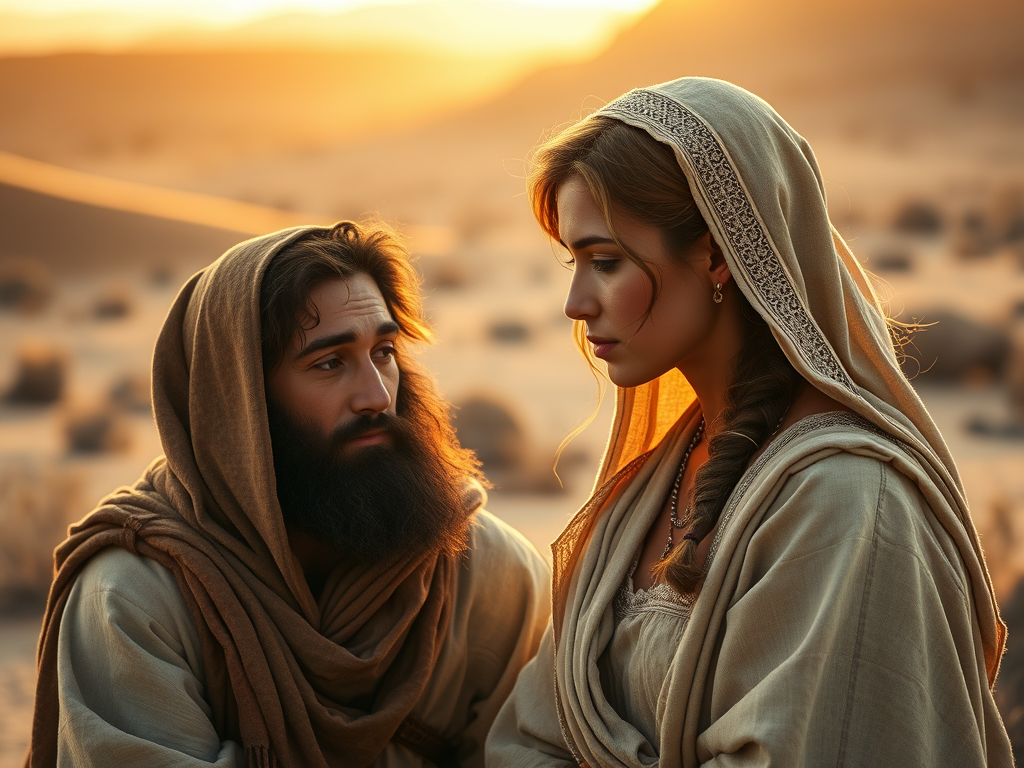
The next morning, the servant asked permission to return to Abraham with Rebekah. The family wanted to delay Rebekah’s departure, but on asking her, Rebekah agreed to go with the servant. The family blessed Rebekah saying, ““Our sister, may you become thousands of ten thousands, and may your offspring possess the gate of those who hate him!” (Genesis 24:60). Let’s look back now at the promises of God to Abraham in Genesis 22:17. That reads “I will surely bless you, and I will multiply your descendants like the stars in the sky and the sand on the seashore. Your descendants will possess the gates of their enemies.” Notice the similarity between the blessings. Again, this confirms that God was involved in Rebekah leaving with the servant. Upon the servant returning with Rebekah, Isaac saw her where he took her into the tent of his mother Sarah, and Rebekah comforted Isaac after his mother’s death.
We now learn that Abraham took another wife, Keturah, who bore him multiple children according to his genealogy. Footnotes indicate that Keturah was likely considered as concubine the same as Hagar. We are then told the sons of Abraham’s concubines were given gifts and sent them eastward away from Isaac, but Abraham gave all that he has to Isaac. At the age of 175 years-old Abraham dies and is buried in the cave with Sarah (Genesis 25.1-11).
We are then given the generations of Ishmael who settled over Arabia, including 12 chieftains as promised by God (Genesis 25:12-18).
Now like Sarah, Rebekah was barren, so Isaac prayed to God and she conceived twins. And the twins struggled even before her giving birth. Upon asking the Lord about this the Lord said, “Two nations are in your womb, and two peoples from within you shall be divided; the one shall be stronger than the other, the older shall serve the younger.” (Genesis 25:23). She gave birth to the twins, Esau first, then Jacob which scripture says was holding the heel of Jacob at birth. Esau grew to be a great hunter and a worker of the field, and was loved by Isaac; while Jacob stayed in tents and was loved by Rebekah (Genesis 25:19-26).
One time Esau came exhausted and asked to eat some of a stew that Jacob had. In return for the stew, Jacob asked for Esau’s birthright which was a special firstborn status. Esau’s response (‘I am about to die, what use is a birthright to me?” Genesis 25:32) showed a lack of appreciation for the value of the birthright, which we will learn is linked to God’s plan for redemption of mankind. Hebrews 12:16 tells us that this was a great sin saying, “See to it that no one is sexually immoral, or is godless like Esau, who for a single meal sold his birthright”.
We now find Isaac settling in Gerar during a famine. There the Lord appears to Isaac and promises to keep the promises to multiply the offspring of Isaac and give them the land of Canaan. (Genesis 26:1-5) There is also the command to not go down into Egypt. Was this perhaps foreshadowing the enslavement that the Israelite’s would face when they settle in Egypt because of Joseph?
We now learn that like his father, Abraham, Isaac is instructing his wife Rebekah to say that she is his sister in order that the men of Gerar do not kill him (Genesis 26:7; Genesis 12:10-20 and Genesis 20). Abimelech, king of the Philistines happens to observe Isaac “laughing with Rebecca”. This had to have been at a moment of deep affection, because on calling Isaac to him, Abimelech says “Behold she is your wife. How then could you say, ‘She is my sister?’” (Genesis 26:9). When Isaac explains the ruse, Abimelech declare that no one should touch Isaac or his wife, or else they would die.
Over time Isaac had become extremely wealthy with many servants leading to the Philistines to become jealous of Isaac. This led Abimelech to tell Isaac to leave because of the strength of his house. Isaac moved and there was a period where Isaac’s servants would dig a well, and herdsmen of Gerar would fill them leading to quarrels. Eventually Isaac settles in Beersheba where the Lord appears to Isaac and tells him not to fear, reiterating that He would multiply Isaac’s offspring, It was there that Isaac built an altar and called upon the Lord (Genesis 26:17-25).
At Beersheba, Abimelech, his advisor Ahuzzath, and his army commander, Phicol visit Isaac. They acknowledge that the Lord is with Isaac and ask to make a pact and covenant with him (Genesis 26:28). Again, like his father, Abraham, they tell Isaac they have treated him well and ask Isaac to do the same (Genesis 26:29; Genesis 21:22-31).
 My Bible Journey In A Year (Chronological)
Leave a comment