Before I start going through Exodus I must address the idea that Exodus did not occur and Hebrews were never enslaved in Egypt according to some historians. Per the ESV notes on the Introduction of Exodus:
“There is plenty of data that seems to corroborate the biblical account: (1) It is most unlikely that a nation should invent a story of its origins as slaves in a neighboring country. (2) The second millennium B.C. was an era when there were many foreigners in Egypt, some of whom were employed making bricks for building projects. (3) The name of the city Raamses is unlikely to have originated or have been remembered later. (4) Some argue that the sequence of plagues related in Exodus fits with the (ecological) situation that accompanies and follows the annual flooding of the Nile. (This need not imply that the plagues were purely “natural.”) (5) The organization of the covenant texts in the Pentateuch (e.g., Exodus 20) fits the pattern of second millennium-B.C. treaties, not later ones. (6) The tent-tabernacle has many parallels in Egypt and Canaan from the second millennium. Indeed, traces of a tent shrine dating from about 1150 B.C. have been found in the wilderness at Timna, not far from the route of the Israelite wanderings. (7) A stele (an inscribed tombstone-like stone slab) from the Egyptian pharaoh Merenptah, c. 1209 B.C., mentions that he had conquered the people of Israel in an invasion of Canaan. This would fit with an exodus from Egypt some time before this and demonstrates that Israel was already settled as a people in Canaan.”
I would concur that archeology does support the Exodus event. Egypt would not need to do a military conquest of the Hebrews living in Egypt. It could have occurred politically as we in some instances see today. Additionally, records of it could have been destroyed due to embarrassment of Egyptian leaders at losing the Hebrews who were seen as a weaker nation. We also do not know exactly when the Hebrews were enslaved, but we do know that the Pharaoh at the time did now know Joseph (Exodus 1:8). So it is reasonable to assume that the events started 70-100 years after Joseph died.
Chapter one starts telling us that the Hebrews multiplied greatly in Egypt (Exodus 1:7). The Pharaoh, who was leading Egypt, did not know about Joseph and was concerned at how great the Hebrew people were in Egypt and decided to set taskmasters over them to burden the people. The idea was to limit their growth due to oppression, but the Hebrew nation still grew. This led to enslavement of the Hebrew nation as the Egyptian people were afraid of the Hebrew nation and their size (Exodus 1: 8-14). This supports my view that the enslavement of the Hebrew people was not done through military action but were the result of edicts from the Pharoah. The length of the enslavement in Egypt again is not known, but we do know that the Hebrews were in Egypt for 430 years (Exodus 12:40). Joseph died at the age of 110 (Genesis 50:26). Figuring Joseph was 40-50 years old when his entire family moved from Canaan to Egypt and adding in 70-100 years after the death for Pharoah to not know of Joseph, this would mean that the Hebrews could have been enslaved by Egypt for almost 300 – 320 years.
Chapter one continues to state that Pharaoh also ordered that if a son were born to a Hebrew woman, the child was to be killed (Exodus 1:16). However, the midwives disobeyed this order due to a fear of God. Pharoah questioned why the sons were allowed to live and the midwives responded that Hebrew women were of a sturdy stick who bore the children before they saw them (Exodus 1: 18-20). The Hebrew nation thus continued to grow. This led to the Pharaoh ordering that all Hebrew male children were to be cast into the Nile (Exodus 1: 22).
Moses was born the son from the house of Levi, and his mother had hidden him for three months. When he was three months old, she made a basket and placed him among the reeds on the riverbank. His sister watched to see what would happen to him. The Pharoah’s daughter found Moses in the basket. Upon this, his sister stepped forward and asked if she should get a Hebrew woman to nurse the child, and Pharoah’s daughter agreed. His sister got their mother who was paid to nurse the child until he was older at which time he was sent back to the Pharoah’s daughter to live as her son. She named him Moses because she drew him out of the water (Exodus 2:1-10).
When Moses grew older (per ESV footnotes, he may have been around 40 years old, he saw an Egyptian beating a Hebrew. Seeing no one was around he killed and hid the Egyptian. However, the killing was discovered and Moses fled to Midian as Pharaoh sought to kill him (Exodus 2: 11-15).
While in Midian, the daughters of a priest were at a trough caring for their flock when shepherds tried to drive the daughters away. Moses came to the daughters aid and helped to care for the flock. They told their father about this, and the father invited Moses to stay with them. In addition, he gave Moses his daughter Zipporah as a wife who had a son, that Moses named Gershom because “I have been a sojourner in a foreign land” (Exodus 2: 16-22).
During this time the people of Israel were crying out due to the harsh conditions of their slavery asking for help. This reached God who remembered the covenant with Abraham and Isaac and Jacob, and “He knew” (Exodus 2: 23-25).
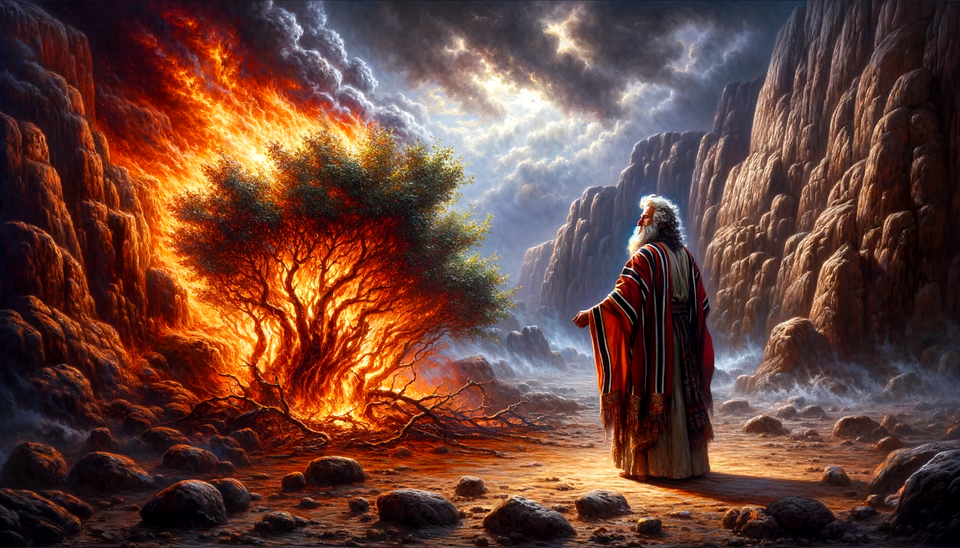
In Chapter 3 we see Moses tending to the flock of his father-in-law, Jethro also known as Ruel (Exodus 2: 18). He was on Horeb, the mountain of God when an angel of the Lord appeared to Moses out of a burning bush. Interestingly, the bush was burning yet was not consumed by the flames. The Lord spoke to Moses telling him to come no closer and take off his sandals for he was on Holy ground (Exodus 3:1-5). It must be noted that the place was not Holy in and of itself but was Holy due to the presence of God. This is a common theme throughout the Bible. God then introduces Himself to Moses as the God of his father and of Abraham, Isaac, and Jacob. This caused Moses to be afraid to look at God. God tells Moses that He has seen how the Hebrews (His children) have suffered in Egypt and that He intends to deliver them from Egypt, and that He wanted Moses to bring His people out of Egypt. Moses asks, “Who am I that I should go to Pharoah and bring the children of Israel out of Egypt?” God tells Moses that He will be with Him. Moses then asks who he should say sent him when he speaks to the children of Israel? God answered, “I AM WHO I AM” and to tell the children of Israel that I AM sent him to them. He is the God of Abraham, Isaac, and Jacob. Further, Moses is to gather the elders of Israel and go with them to Pharoah, and ask for a 3 days journey in the wilderness to sacrifice to God. God would present wonders to Pharoah to compel him to let them go. And when they go, they will ask for silver, gold, and clothing for the journey to plunder Egypt (Exodus 3: 1-22).
In chapter 4, Moses persisted in saying that the people would not believe Him. So, God gave Moses three signs to demonstrate His power. First, the Lord had Moses throw down his staff, which became a snake when Moses did so causing Moses to run. But when the Lord had Moses pick up the snake by its tail, it again became a staff. The Lord then had Moses put his hand in his cloak. When Moses pulled it out the hand was white with leprosy. The Lord had Moses replace his hand in his cloak, and the second time Moses pulled it out, the hand had recovered. God then told Moses for the fourth sign he should draw water from the Nile, and when he pours it on the ground it will be like blood (Exodus 4: 1-9).
Moses then tells God that he is not eloquent, but rather slow in his speech. The Lord questions Moses asking him “who made his mouth?”, and reminded Moses that He would be with Moses and teach Him what to say. Moses then asked for the Lord to send someone else. God is now angry with Moses. The Lord states that his brother Aaron the Levite was coming to meet Moses, and that Moses was to meet him and be glad. God would send Aaron with Moses and teach both of them. Moses is to tell Aaron what to say, and Aaron will speak Moses’ words and Moses would be like God to Aaron. God then tells Moses to take his staff which will be used for the signs from God (Exodus 4: 10-17).
After talking to his father-in-law saying that he wanted to see his brothers in Egypt, Moses prepared to go with his wife and left when the Lord told him that those who sought to kill him had died. The Lord told Moses to go to Pharoah and perform the miracles God had planned. Pharoah’s heart would be hardened by the Lord and he would refuse. The Lord then told Moses to say “Thus says the Lord, Israel is my first-born son. And I say to you “Let my son go so that he may serve Me”. If you refuse to let him go, Behold I will kill your first-born son.” The Lord was telling Moses that He remembered the covenant with Abraham and that He would bring Israel to the land He promised. That makes what happened next important. Scripture states that on their way to Egypt the Lord sought to kill Moses. Zepporah had circumcised Moses’ son, and touched Moses feet with it saying “Surely you are a bridegroom of blood to me”. Basically she is now connecting Moses to the act that she performed. Scripture also states that then the Lord left Moses alone, meaning removed His intent to kill Moses. This shows how important the covenant between Abraham and the Lord was (See Genesis 17). By not circumcising his son as the covenant commanded, Moses put his life in danger. However, by his wife correcting this Moses was no longer in danger (Exodus 4:18-26).
Aaron was told by the Lord to meet Moses in the wilderness. Aaron went and met Moses at the mountain of God, where Moses told Aaron all he was to say and the signs that Moses was commanded to do. When Moses and Aaron arrived in Egypt, they gathered the elders and spoke what the Lord told them to say. And when they performed the signs in the sight of the people, they believed and realized that God had heard their cries of oppression and worshiped Him (Exodus 4: 27-31).
 My Bible Journey In A Year (Chronological)
Leave a comment