
We pick up now with a disturbing story of Judah. He left his brothers and married a Canaanite woman. The firstborn of his sons to this woman is Er who married Tamar as arranged by Judah. Now Er was a wicked man in the sight of the Lord, resulting in the Lord putting him to death (Genesis 38: 7). We are not told what Er has done that was deserving of this punishment, but we can imagine it was horrible.
Judah went to Er’s brother, Onan, and told him to go in with Tamar and provide her offspring to raise as Er’s to carry on the firstborn line. This command was in line with the “levirate marriage” which requires a brother to marry his brother’s childless widow in order to provide her children (Deuteronomy 25:5-10; ESV footnote). So, this is an important ritual that continued. Onan, realizing that any child he had with Tamar would not be considered his, did not complete intercourse with Tamar but wasted his semen so as to not get her pregnant. This was likely due to Tamar’s children having higher importance than his own children in the family line. Either way, this was seen as evil in the eyes of God, and Onan too was put to death by the Lord (Genesis 38:10). Due to this, Judah ask Tamar to live within his household as a widow rather than marry his third son, Shelah, as Judah feared that Shelah would die as well.
Over time, Judah’s wife also dies, leaving Judah a widower. Tamar in the meantime was waiting for Judah to fulfill the promise to provide her children through Shalah who had now grown up. After a period of mourning, Judah traveled to Timnah. Tamar decided she had enough and took off her widow’s garments and clothed herself in a veil and sat at the entrance to Enaim, which was on the way to Timnah. Judah mistook her for a prostitute and when he passed by her, asked if he could spend time with her. Judah offers her a goat for the time, but Tamar asks for his signet, his cord, and his staff until he sends the goat. These would be items by which Judah would be recognized. Judah agrees and Tamar conceives by Judah, after which she returns and again dresses in her widow’s dress.
Judah later sends a your goat to get his signet, cord, and staff back. However, Tamar is now gone from where he left her. Judah determined to let her keep the things rather than be laughed at being he had been with what he assumed was a prostitute. He still did not know it was Tamar.
After three months’ time, Judah was told that Tamar was pregnant through immorality, leading Judah to demand that she be burned. As she was brought out, she presented the items that were given to her and said the man who owned them was the father of her child. Judah recognized his own sin in not giving Shelah to Tamar as promised declaring her more righteous than he was (Genesis 38: 26). Tamar eventually gives birth to twin boys, Perez and Zerah.
We now turn our attention back to Joseph. He had been sold by the Ishmaelites to Potiphar, the captain of the guard for Pharoah in Egypt. And the Lord was with Joseph and there was only success in all he did. Potiphar noticed this and made Joseph overseer over his house, so the Lord blessed his house on account of Joseph. Eventually Potiphar’s wife desired Joseph and asked him to lie with her. Jospeh refused noting how Potiphar entrusted him with everything he had except his wife, noting this would be a sin against God. This is important, because Joseph was more worried about the sin against God than against Potiphar,
One day Joseph was alone in the house with Potiphar’s wife. She again asked Joseph to lie with her, and he again refused fleeing the house but leaving his garment. Potiphar’s wife told the men of the household, and eventually Potiphar himself, a lie that Jospeh was a Hebrew brought into the house who left his garment beside her and laughed at her, describing Joseph as “your servant” to Potiphar. Of course, Potiphar is angered at this report and has Joseph thrown in prison where the king’s prisoners were confined. Again, the Lord was with Joseph and even in jail, God showed Joseph love and success where the jailer put Joseph in charge all the prisoners.
At some point, Pharoah’s cupbearer and baker committed offenses where they were sent to prison and Joseph was in charge of them. While in prison, they had dreams which troubled them and Joseph asked them to tell him the dreams so that he could help, noting that interpretations belong to God (Genesis 40:8). Again, attention is drawn to Joseph’s level of faith. He does not take any credit for himself in dream interpretation, but that belongs to God.
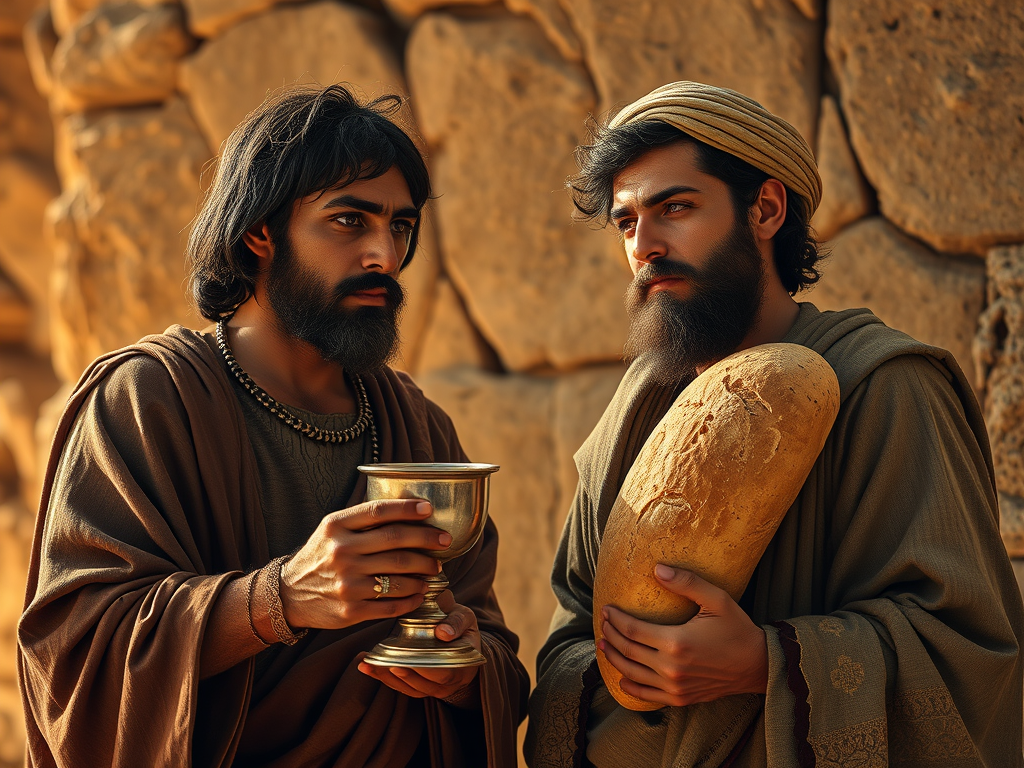
The cupbearer goes first and describes a vine with three branches that blossom into grapes which the cupbearer pressed into Pharoah’s cup and gave it to Pharoah. Joseph explains that within three days Pharoah would restore him as a cupbearer. He asks that the cupbearer remember him and have him released from the prison as he has done nothing wrong to be in prison.
The chief baker saw that the interpretation for the cupbearer was favorable, so he told of his dream. In his dream, there were three baskets of bread on his head, with the uppermost for Pharoah but birds were eating from the basket directly on his head. Joseph told him that in three days Pharoah would hang the chief baker, and birds would eat his flesh.
Three days later was the Pharoah’s birthday. On that day, as Joseph interpreted, the cupbearer was restored to his office, and the chief baker was hanged. Unfortunately, the cupbearer did not remember Joseph.
 My Bible Journey In A Year (Chronological)