We now turn our attention to the book of Job. It is one of the books of wisdom. We do not know much about it. There is no known author that we can point to and there is great debate as far as when it was written. Chronologically it places the book at the same timeframe of the patriarchs (Abraham, Isaac, and Jacob). The setting is Uz, which is related to Edom, who would be related to Esau based on Genesis 25:30 where Esau was called Edom.
The book of Job starts off with an introduction to Job, who is already wealthy and it is noted that he was the greatest man in the east (Job 1:3). Interestingly, while Job is a righteous man, his children may not have been as righteous. Job had seven sons and three daughters. The sons would have feasts in each of their houses. At the end of the feasting Job would give an offering to God for each of his children saying, “It may be that my children have sinned and cursed God in their hearts” (Job 1:5). Having partied in my youth, I know what Job is saying here. I am guilty of having done the same, turning away from God toward more worldly pleasures. Pleasures that never lasted.
We then learn that God had met with the sons of God. My ESV reference indicates that this would be a group like a council that met before God. This is quite literally a meeting amongst spiritual beings. The book says that at some point Satan also came among them. Based on scripture indicating he “came among them” Satan is not a part of this council of spiritual beings. The Lord addresses Satan and asks, “From where have you come from?” Satan responds that he has been wondering the Earth. God then asks, “Have you considered My servant Job? For there is no one on earth like him, a man who is blameless and upright, who fears God and shuns evil.” Job 1:8).Satan responds that Job has a right to fear God as God placed a hedge around his house and all within it, blessing Job in all that he does. But if God were to remove protection from Job, Job would curse God (Job 1:9-12). So, God allows Satan to test Job and removes his protection.
Satan attacks Job severely. First, he sends the Sabeans and struck down Job’s servants taking his oxen and donkeys. Second, fire from the heavens came down and killed all Job’s sheep and servants. Third, the Chaldeans came and took Job’s camels killing the servants that were with them. Fourth, a great wind brought down a house where Job’s sons and daughters were feasting, killing them all. We learn that this comes in rapid succession as scripture says the lone survivors from each of the events were still speaking, when another survivor would arrive to tell his tragic news of what occurred. Job affirms later “For He crushes me with a tempest and multiplies my wounds without cause, but He will not let me get my breath but fills me with bitterness” (Job 9:17-18). The response of Job to these tragedies is to tear his robe, shave his head, and worship God. His words of faith are remarkable! “The Lord gave and the Lord has taken away. Blessed be the name of the Lord” (Job 1:21). Scripture tells us that in all this tragedy, Job never sinned or blamed God for his misfortune.
Again, God is meeting with the sons of God, when Satan appears a second time. God again asks if Satan considered Job who held to his faith despite the tragedies that Satan caused God to allow to happen to Job. Satan insinuates that Job would not curse God because he was spared from physical hard despite the great tragedy. Basically, he was saying Job was praising God that it was others who died and he was not harmed. So, God allowed Satan to test Job again, but Satan must spare the life of Job. In this test, Job developed sores that went from his feet to his head. Job’s wife was saying that Job should now curse God, but Job responded, “Shall we receive good from God, and not receive evil” (Job 2:9). And yet Job did not sin.
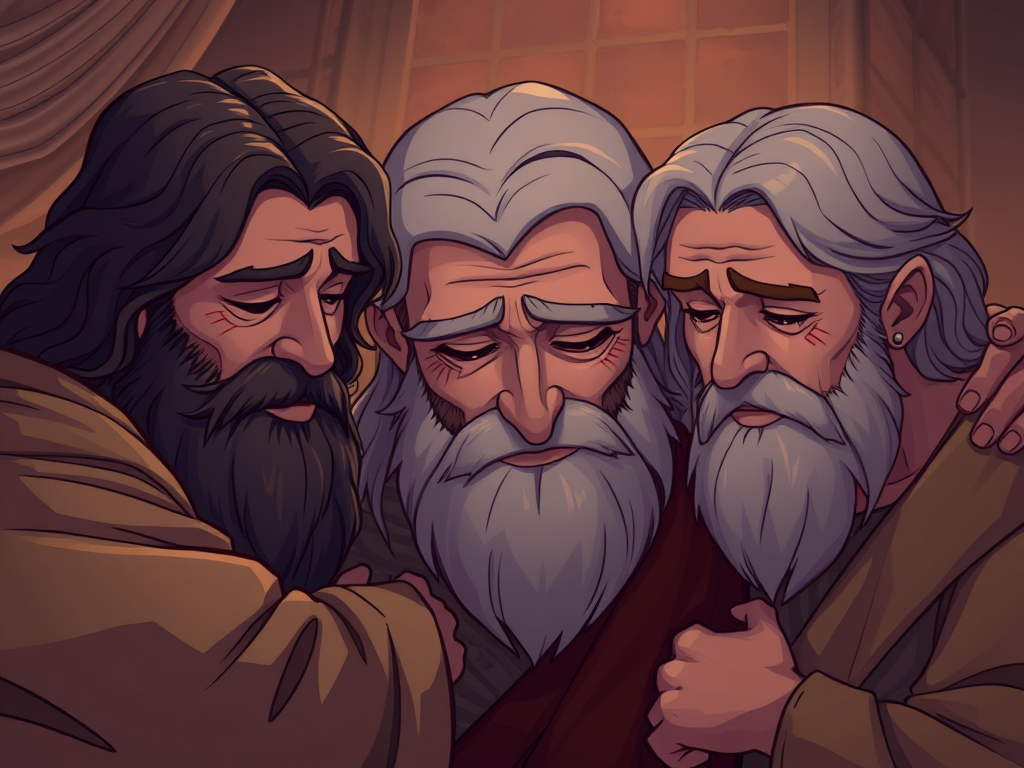
We now come to the three friends of Job who set off to visit him and comfort him. They are Eliphaz the Temanite, Bildad the Shuhite, and Zophar the Naamahite. Do these names sound familiar? They should. Eliphaz was the name of one of Esau’s whose was a chief – Teman (Genesis 36:11, 15). Bildad was a Shuhite, and one of Abraham’s sons through Keturah was Shuah (Genesis 25:2). Finally, Zophar was a Naamahite. Naamah. which is the same name of one of Cain’s daughters (Genesis 4:22). While we don’t know much more about these men, we can know discern that the events actually happened as thy are at least connected to real people and places that would have existed in the later years of Jacob.
When men arrive where Job is, they did not recognize Job at first. Part of this is due to the sores Job has. Part also could be due to the mourning and grieving which likely was manifesting physically as we will soon learn. Job’s physical appearance bothered them so much they wept and tore their robes.
After a period of mourning, Job laments that he was ever born. Saying of the day of his birth he says, “Behold let that night be barren, let no joyful cry enter it.” (Job 3:7). He then longs for death at which point he can rest stating “For then I have laid down and been quiet; I would have slept; then I would have rest” (Job 3:13). He then compares various people the rich and the poor, the master and the slave – all at rest together with no one escaping it. Yet while talking about his longing for death to end his misery, Job notes that God has provided light saying, “Why is light given to a man whose way is hidden, whom God has hedged in” (Job 3:23). Despite his longing for the torment to end in death, God provides hope through a light and Job is reminded that God has a hedge around him – the opposite of what Satan contended would happen.
Eliphaz is the first of the friends to talk to Job. He reminds Job that many have learned from Job and been strengthened through Job (Job 4:3-4). But then he accuses Job of being impatient and having iniquity in his life leading to the torment that Job is now in (Job 4:8-11). Eliphaz then apparently seeks to explain to Job that all creation dies in sin, including angels (J0b 4:12-21). He further explains that due to sin we are all born to face troubles throughout our life (Job 5:1-7). He encourages Job to seek God (Job 5:8-15). and then God will turn his reproof into healing *(Job 5:17-22). At that point Job will find rest, as well as his household (Job 5:23-27).
 My Bible Journey In A Year (Chronological)